Print — Ordinary Post + Sharadiya Registered Magazine Post
Monthly by ordinary post; Saradiya by registered magazine post
₹310
Total for 1 year
Founded by Swami Vivekananda · Published since 1899
The Bengali monthly of the Ramakrishna Order.
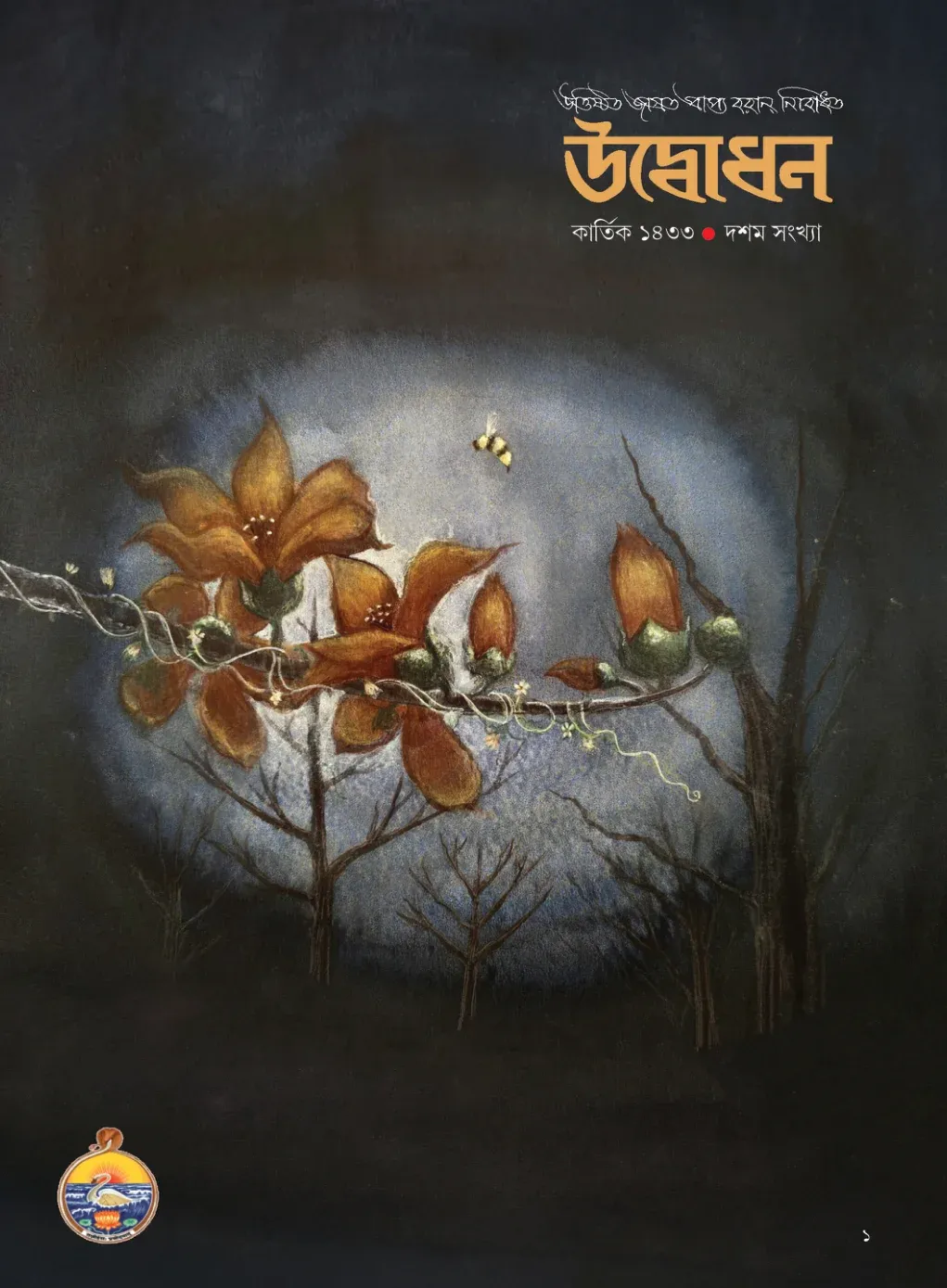
October 2026
Explore the issue and its contents. An active digital subscription gives you access to subscriber-only pages.
Choose the printed magazine or read online. Prices shown cover the full selected subscription term.
Registered Magazine Post
For reliable, uninterrupted delivery, subscribe through Registered Magazine Post — every issue ships with a Tracking ID and SMS delivery updates.
Limited-period discount on 3-year & 5-year subscriptions through Registered Magazine Post.
Printed magazine, posted to you
Monthly by ordinary post; Saradiya by registered magazine post
₹310
Total for 1 year
Monthly, with Tracking ID and SMS service
₹500
Total for 1 year
Monthly, by air mail
₹4,000
Total for 1 year
Prices as published by the office. The plans above are what you can pay for online; for collection by hand, please contact the office.
The office’s current registered-post offer applies to three- and five-year subscriptions. Tracking and SMS updates are included.
If ordinary post is not reaching you, switch to registered magazine post, or collect the Patrika through your nearest subscription centre; contact the office for the list of centres.
Subscriptions · 8265 82 65 65The Patrika welcomes essays and poems from its readers. Please read these guidelines from the editorial office before sending a piece.
Essays: up to 2,000 words. Poems: up to 15 lines.
First published on 14 January 1899 under Swami Trigunatitananda’s editorship, Udbodhan began as a fortnightly. It became a monthly in 1908. Its story is closely linked to Sri Sarada Devi’s Kolkata home at Baghbazar, known as Mayer Bari.
উত্তিষ্ঠত জাগ্রত প্রাপ্য বরান্ নিবোধত॥Arise, awake, and learn by approaching the great ones.
On the cover of every issue, chosen by Swami Vivekananda
The Patrika’s 125th year was celebrated at Girish Mancha on 15 January 2023.
The 125th-year celebrationHistorical account in English, with original quotations
Swami Vivekananda returned from the West to India in January 1897 and founded the Ramakrishna Mission on 1 May that year. He had long felt that the new ideas needed a literature of their own: while still in America he had encouraged Alasinga Perumal to start the Brahmavadin, and when Swami Trigunatitananda (স্বামী ত্রিগুণাতীতানন্দ) wrote of his wish to bring out a Bengali journal, Swamiji kept urging him on by letter.
Towards the end of 1898 a printing press was bought and set up in the house of Girindralal Basak at 14 Ramchandra Maitra Lane, Kambuliatola, Kolkata. It was named the Udbodhan Press, and this rented house was the first Udbodhan Karyalaya. From it, on 14 January 1899 (1 Magh 1305), the first number of Udbodhan appeared as a fortnightly, with Swami Trigunatitananda as editor.
Swamiji gave the journal its name, chose the line from the Upanishads that still stands on its cover, and wrote the prospectus (প্রস্তাবনা) for the first issue. Swami Trigunatitananda was at once editor of the paper and manager of the press and office; Swami Shuddhananda (স্বামী শুদ্ধানন্দ) was his assistant, and began translating Swamiji's English lectures and writings into Bengali for its pages.
Late in the year a press is bought and set up in Girindralal Basak's house at 14 Ramchandra Maitra Lane, Kambuliatola — the Udbodhan Press, and the first Udbodhan Karyalaya.
১ মাঘ ১৩০৫
On 14 January 1899 Udbodhan appears as a fortnightly, edited by Swami Trigunatitananda. Swami Vivekananda names it, chooses its cover motto and writes its prospectus.
বৈশাখ ১৩০৬
Swamiji's Rajyoga, in Bengali translation, is the Karyalaya's first book. Bhaktiyoga and Karmayoga follow in 1900.
After the eighteenth number of the fourth year the journal's own press has to be sold; Udbodhan is printed at other presses from then on. The same year the first volume of Sri Sri Ramakrishna Kathamrita is published.
Swami Trigunatitananda leaves for America and the journal nearly stops. Swami Shuddhananda takes over editing and publishing; Swami Saradananda becomes closely involved.
In November the office moves to 30 Bosepara Lane. On 18 July the same year Kedarchandra Das registers the Baghbazar plot on which Mayer Bari will stand.
মাঘ ১৩১৪
From its tenth year Udbodhan becomes a monthly. In November the Karyalaya moves into its own house at 12–13 Gopal Chandra Neogi Lane, and Swami Saradananda takes full charge.
৯ জ্যৈষ্ঠ ১৩১৬
On 23 May 1909 Sri Sarada Devi arrives at the new house. For eleven years the journal is edited and published under her roof.
Sharat Maharaj, who ran the Karyalaya from 1908 and was editor or joint editor for much of that time, passes away on 19 August 1927.
মাঘ ১৩৭৯
From the 75th year, by order of Belur Math, the head of Mayer Bari is ex officio editor of Udbodhan, with a joint editor doing the day-to-day work.
বৈশাখ ১৪০০
Belur Math separates the editor's post from the headship of Mayer Bari; the head becomes managing editor.
In the prospectus Swamiji set out what he called the life-purpose (জীবনোদ্দেশ্য) of Udbodhan. He described two great rivers of human thought: the ancient Indian, given to the deepest reflection and to spiritual ideas that have crossed rivers, mountains and seas into the veins of other nations; and the Greek, given to tireless effort, the mastery of the visible world and the creation of earthly beauty, of which all Europe is today the pupil and heir.
Whenever these two streams have met, he wrote, civilisation has been lifted on a great spiritual wave and the bond between human beings has grown stronger. It happened once in antiquity, again with the rise of the Arabs, and the time for such a meeting had, he believed, come again — "এবার কেন্দ্র ভারতবর্ষ" ("this time the centre is India"). The union of India's spiritual knowledge with the West's knowledge of the world was to be the ideal of the new age, and India was to lead the world to it.
He did not spare his own countrymen: modern Indians, he wrote, were no longer the glory of the ancient Aryan line, and had let the country sink into inertia in the name of religion. The way out was to bring India's own high thought back into living practice and to keep it before the people. "এই দুই শক্তির সম্মিলনের ও মিশ্রণের যথাসাধ্য সহায়তা করা 'উদ্বোধনের' জীবনোদ্দেশ্য" — to help, as far as it can, the meeting and mingling of these two forces: that is the life-purpose of Udbodhan.
উদ্বোধনে সাধারণকে কেবল Positive Ideas দিতে হবে। … Positive Ideas দিতে পারলে সাধারণে মানুষ হয়ে উঠবে ও নিজের পায়ে দাঁড়াতে শিখবে।
In Udbodhan the people must be given only positive ideas. … If we can give them positive ideas, ordinary people will become truly human and learn to stand on their own feet.
Udbodhan began as a fortnightly and became a monthly from its tenth year, and has been published that way ever since. Up to the eighteenth number of the fourth year it was printed on its own press; the press then had to be sold, and the journal has been printed at other presses since.
In 1903 Swami Trigunatitananda left for America, and the journal came close to closing. At Swami Brahmananda's wish and through Swami Saradananda's efforts the crisis passed: Swami Shuddhananda was given charge of editing and publishing, and his devotion and hard work kept Udbodhan going. From this time Swami Saradananda (Sharat Maharaj) was closely tied to the journal; from November 1908 he took full charge of the Karyalaya.
The office had moved from Girindralal Basak's house to 30 Bosepara Lane in November 1906, after his death. In November 1908 it moved into its own newly built house at 12–13 Gopal Chandra Neogi Lane, which, because it also fronted Mukherjee Lane, took the address 1 Mukherjee Lane — later renamed Udbodhan Lane. This is the house that became the Holy Mother's Kolkata home, Mayer Bari (শ্রীশ্রীমায়ের বাড়ী).
As the readership and the work grew, a plot about 200 feet from Mayer Bari was bought while Swami Jnanatmananda was head, and a four-storey Karyalaya building was raised on it in stages: begun under Swami Nityaswarupananda, carried up to three floors under Swami Vishwashrayananda, and completed with the fourth under Swami Hiranmayananda. The ground floor holds the office, the head's office, the sales room, the book store and accounts; the first floor the subscription and collection department, advertising, proof-reading and the Swami Saradananda Hall where readings and lectures are held; the second floor the editor's office and residence and a public library; the top floor is the monks' quarters.
Swamiji's writings reached Bengali readers through the Patrika first and then as books. Rajyoga (রাজযোগ), published in Baishakh 1306 (1899), was the Karyalaya's first book; Bhaktiyoga followed in Ashadh 1307 and Karmayoga in Bhadra 1307 (1900), all three translated from Swamiji's English originals. Once the Bengali translations were out, the Karyalaya began publishing the English texts too, and by 1308 (1902) it had brought out Rajyoga, Karmayoga, Jnanayoga, Bhaktiyoga and the Chicago lectures in Bengali, and the same titles with the Letters and Conversations in English. Swamiji's own Bengali work Prachya o Paschatya (প্রাচ্য ও পাশ্চাত্য), serialised in the Patrika, appeared as a book soon after.
The first volume of Sri Sri Ramakrishna Kathamrita (শ্রীশ্রীরামকৃষ্ণকথামৃত), by Sri M., was published in 1902. In 1910 Sister Nivedita's The Master as I Saw Him came out from Udbodhan and in England at the same time. Much of this rests on Swami Shuddhananda, who from the beginning helped with the Patrika and translated almost the whole of Swamiji's English writings into Bengali single-handed — faithful to the original, and in his own fluent prose.
Swami Saradananda's Sri Sri Ramakrishna Lilaprasanga (শ্রীশ্রীরামকৃষ্ণলীলাপ্রসঙ্গ), the authoritative life of Sri Ramakrishna in five parts, was written in his small ground-floor room at Mayer Bari and is the Karyalaya's best-known work. Later came Yuganayak Vivekananda, Sri Ma Sarada Devi, Sri Ramakrishna Bhaktamalika, a day-by-day edition of the Kathamrita with indexes, and the four-volume Vedanta Darshan. By 2014 the Karyalaya had published and printed about three hundred books.
The historical record below comes from the Karyalaya’s booklet, reprinted in March 2014. It does not include every later appointment.
Magh 1305 – Poush 1309 (1899–1903)Volumes: 1–4
Swami Trigunatitananda
Magh 1309 – Poush 1314 (1903–1908)Volumes: 5–9
Swami Shuddhananda
Magh 1314 – Poush 1318 (1908–1912)Volumes: 10–13
Swami Saradananda
Magh 1318 – Poush 1320 (1912–1914)Volumes: 14–15
Swami Prajnananda
Magh 1320 – Poush 1322 (1914–1916)Volumes: 16–17
Swami Saradananda
with Brahmachari Nirmal (Swami Madhavananda) as working editor
Magh 1322 – Poush 1326 (1916–1920)Volumes: 18–21
Swami Saradananda
with Brahmachari Bimal (Swami Dayananda) and Brahmachari Shantichaitanya (Swami Gangeshananda) as working editors
Magh 1326 – Shraban 1329 (1920–1922)Volumes: 22–24
Swami Vasudevananda
Bhadra 1329 – Shraban 1334 (1922–1927)Volumes: 24–29
Swami Saradananda and Swami Vasudevananda
Bhadra 1334 – Ashwin 1342 (1927–1935)Volumes: 29–37
Swami Shuddhananda and Swami Vasudevananda
Kartik 1342 – Ashwin 1343 (1935–1936)Volumes: 37–38
Swami Shuddhananda and Swami Sundarananda
Kartik 1343 – Chaitra 1358 (1936–1952)Volumes: 38–54
Swami Sundarananda
Baishakh 1359 – Poush 1363 (1952–1957)Volumes: 54–58
Swami Shraddhananda
Magh 1363 – Poush 1371 (1957–1965)Volumes: 59–66
Swami Niramayananda
Magh 1371 – Poush 1379 (1965–1973)Volumes: 67–74
Swami Vishwashrayananda
Magh 1379 – Magh 1384 (1973–1978)Volumes: 75–80
Swami Vishwashrayananda
ex officio as head of Mayer Bari; joint editors Swami Jivananda (Magh 1379 – Poush 1380) and Swami Dhyanananda (from Magh 1380)
Falgun 1384 – Chaitra 1384 (1978)Volumes: 80
Swami Atmasthananda
ex officio as head of Mayer Bari; joint editor Swami Dhyanananda
Baishakh 1385 – Ashadh 1388 (1978–1981)Volumes: 80–83
Swami Hiranmayananda
ex officio as head of Mayer Bari; joint editor Swami Dhyanananda
Shraban 1388 – Agrahayan 1391 (1981–1984)Volumes: 83–86
Swami Niramayananda
ex officio as head of Mayer Bari; joint editors Swami Dhyanananda (to Bhadra 1389) and Swami Abjajananda (from Ashwin 1389)
Poush 1391 – Falgun 1395 (1984–1989)Volumes: 86–91
Swami Nirjarananda
ex officio as head of Mayer Bari; joint editors Swami Abjajananda (to Ashwin 1392), Swami Prameyananda (Poush 1392 – Ashwin 1394) and Swami Purnatmananda (from Kartik 1394)
Chaitra 1395 – Chaitra 1399 (1989–1993)Volumes: 91–95
Swami Satyabratananda
ex officio as head of Mayer Bari; joint editor Swami Purnatmananda (to Poush 1396)
Baishakh 1400 – Baishakh 1407 (1993–2000)Volumes: 95–103
Swami Purnatmananda
managing editor Swami Satyabratananda (Baishakh 1400 – Magh 1412)
Jyaishtha 1407 – Kartik 1411 (2000–2004)Volumes: 103–107
Swami Sarvagananda
managing editor Swami Satyabratananda
Agrahayan 1411 – Poush 1415 (2004–2009)Volumes: 107–110
Swami Shivapradananda
managing editors Swami Satyabratananda (to Magh 1412) and Swami Mumukshananda (from Falgun 1412)
Magh 1415 – Shraban 1420 (2009–2013)Volumes: 111–115
Swami Ritananda
managing editor Swami Mumukshananda (to Baishakh 1420)
Bhadra 1420 – Poush 1425 (August 2013 – December 2018)Volumes: 115–120
Swami Chaitanyananda
Magh 1425 – Poush 1427 (January 2019 – December 2020)Volumes: 121–122
Swami Shivarchanananda
Magh 1427 – (January 2021 – )Volumes: 123–
Swami Krishnanathananda
current editor
From Magh 1379 (the 75th year of Udbodhan, 1973), by direction of the Belur Math authorities, the head of Sri Sri Mayer Bari was ex officio editor of Udbodhan; the working editor was styled joint (যুগ্ম) or associate (সংযুক্ত) editor.
From Baishakh 1400 (1993), again by direction of Belur Math, the editor's post was separated; from then the head of Mayer Bari has been managing editor (ব্যবস্থাপক সম্পাদক).
The joint editors in that period were Swami Jivananda (Magh 1379 – Poush 1380), Swami Dhyanananda (Magh 1380 – Bhadra 1389), Swami Abjajananda (Ashwin 1389 – Ashwin 1392), Swami Prameyananda (Poush 1392 – Ashwin 1394) and Swami Purnatmananda (Kartik 1394 – Poush 1396); the managing editors since 1400 were Swami Satyabratananda (Baishakh 1400 – Magh 1412) and Swami Mumukshananda (Falgun 1412 – Baishakh 1420).
Choose print or digital, then select an available duration.
Check your details and complete payment. Digital access is linked to your sign-in email.
Digital access begins after payment is confirmed. For printed copies, check dispatch details with the office.